
Food and beverage stainless steel storage tank technology selection and application points in depth analysis. This article explains in detail the technical requirements of storage tanks in the dairy, beverage, condiment industry, to provide volume calculation, temperature control, cleaning system configuration program. Wenzhou shun rising machinery specializing in the manufacture of sanitary stainless steel tank equipment, to provide customers with customized solutions and installation and maintenance support.
I. Analysis of equipment specifications and industry standards
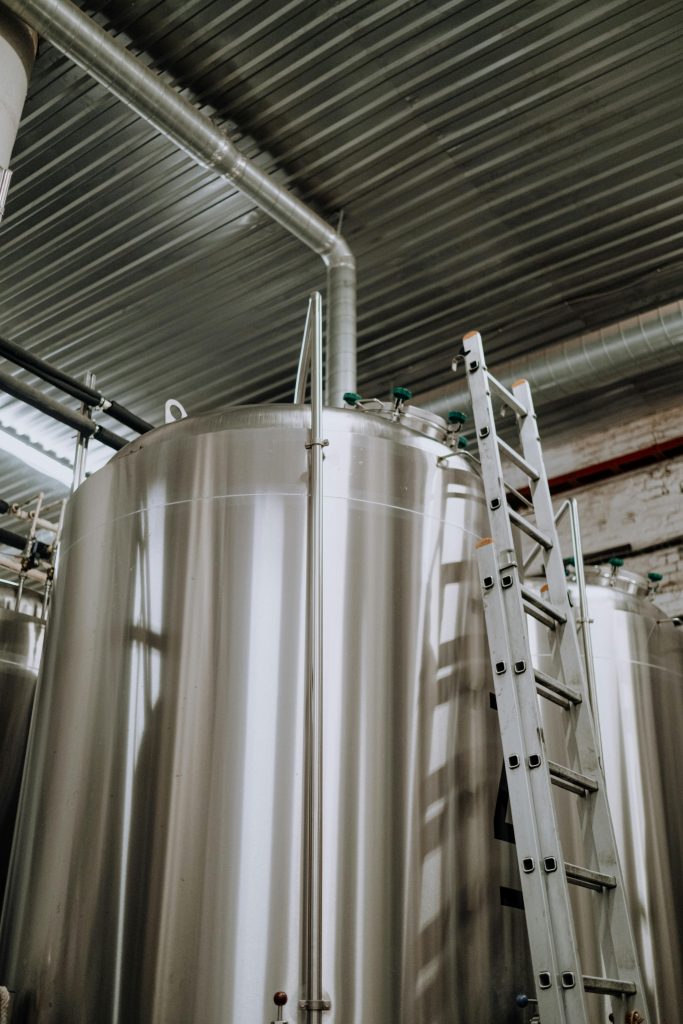
Stainless steel tanks as a key storage equipment in the food and beverage production process, its design and manufacture need to strictly follow a number of industry technical standards. According to the characteristics of materials, process requirements and production scale, the technical parameters of the tank there are significant differences.
Core material selection basis:
304 stainless steel: for general food, beverage, dairy products and other neutral or weakly acidic environment, with good corrosion resistance and processing performance, in line with theGB 4806.9-2016 National standard for food safety Metal materials and products for food contactRequest.
316L Stainless Steel: Containing molybdenum (2-3%), the corrosion resistance is significantly improved, especially suitable for containing chlorine ions, acidic fruit juices, spices, fermentation products and other materials, in the field of pharmaceuticals and bio-engineering also has a wide range of applications.
Volume calculations and structural design:
The effective volume of the storage tank needs to be calculated according to the production batch volume, material residence time, cleaning cycle and other factors. The common formula for volume calculation is: V = Q × t / η, where Q is the hourly handling capacity, t is the residence time, and η is the filling factor (usually 0.8-0.9). The structural design needs to consider the form of head (standard elliptical head, disk head, conical head), the support method (outrigger type, lug type, skirt seat type) and the reasonableness of interface configuration.
II. Special technical requirements for the food and beverage sub-sector
- Tank Application Highlights for the Dairy Industry
In dairy production, stainless steel storage tanks not only need to meet the basic hygiene requirements, but also need to have precise temperature control capabilities. Pasteurized milk, UHT sterilized milk, fermented milk and other different products on the tank insulation performance, stirring uniformity, CIP cleaning effect have special requirements. Especially in the fermented milk production process, the tank needs to maintain a constant fermentation temperature (usually 40-45 ℃), temperature fluctuations need to be controlled within ± 0.5 ℃. - Beverage industry tank technology considerations
Carbonated beverage tanks need to be designed according to pressure vessel standards, the working pressure is usually 0.3-0.6MPa, need to set safety valves, pressure gauges and other safety accessories. Juice tanks need to focus on the corrosion of acidic materials, 316L stainless steel tanks, the inner surface of the electrolytic polishing treatment (Ra ≤ 0.4μm) can effectively reduce the material residues and microbial adhesion. Tea drinks, protein drinks and other products also need to focus on the tank's antioxidant design and anti-odor pollution measures. - Recommendations for the selection of storage tanks in the flavoring industry
Stainless steel storage tanks in the production of soy sauce, vinegar, sauces and other condiments need to consider the corrosion resistance requirements of the high salt and high acidity environment. The quality of the passivation treatment of the inner wall of the storage tank directly affects the service life of the equipment, and it is recommended that the passivation layer be tested and maintained regularly. For seasonings that require long-term fermentation, the tank's sealing performance and micro-oxygen control capability become key selection factors.
III. Configuration and optimization of storage tank attachment systems
- Temperature control system refinement design
Stainless steel tanks according to process requirementsCan be configured with jacket heating/cooling, built-in coil, external insulation and other temperature control methods. Jacket design needs to reasonably calculate the heat transfer area to ensure that the heating/cooling efficiency; coil arrangement should be avoided dead ends, easy to clean; insulation materials need to be considered in the selection of thermal conductivity, fire rating, environmental performance and other factors. Modern food factories, more and moreTank equipment began to integrate PLC automatic temperature control systems for precise programming and remote monitoring of temperature profiles. - Scientific configuration of the mixing system
For materials that need to be mixed, homogenized, or suspended, tanks with agitators are a necessary choice. The type of agitator (paddle, turbine, propeller), speed range, and power configuration need to be calculated and selected according to the viscosity, density, and mixing requirements of the material. Top-entry mixing is suitable for most food and beverage materials, while side-entry mixing is more suitable for the mixing needs of large volume tanks. The selection of mixing shaft seal (mechanical seal, packing seal) needs to consider the hygiene level and sealing reliability. - Integrity verification of cleaning and sterilization systems
CIP (cleaning in place) system is one of the core configurations of sanitary tanks. The selection and arrangement of cleaning devices such as fixed spray balls and rotary cleaners should ensure that all internal surfaces are covered, and the cleaning coverage should reach 100%. The parameter settings (temperature, concentration, time, flow rate) of the cleaning procedures (pre-rinse, alkaline rinse, acid rinse, final rinse) should be verified and validated, and the SIP (Sterilization-in-Place) system is mainly used in the production of pharmaceuticals and high-end food products, which requires that the tanks be able to withstand steam sterilization conditions at 121°C for 30 minutes. SIP (Sterilization In Place) systems are mainly used in pharmaceutical and high-end food production, requiring tanks that can withstand steam sterilization conditions at 121°C for 30 minutes.
Fourth, the whole process control of installation and commissioning and maintenance management
- Quality control during the installation phase
Stainless steel tanks need to be installed before the acceptance of the foundation to ensure that the level, load-bearing capacity in line with the design requirements. The lifting process needs to use special spreader to avoid equipment deformation. Pipe connections should be sanitary quick-fit fittings to reduce dead space. Pressure test, leakage test, cleanliness check and other multiple verifications are required after the installation is completed. - Standardized operations for routine maintenance
Establish a perfect maintenance system for storage tank equipment, including daily inspection (checking seals, fasteners, instrumentation), regular maintenance (replacing seals, lubricating bearings), preventive maintenance (corrosion detection, wall thickness measurement) and so on. Maintenance records should be detailed and complete for traceability and analysis. - Performance Validation and Continuous Improvement
Regular performance verification of stainless steel storage tanks, including capacity calibration, temperature uniformity test, cleaning effect verification, etc.. According to the verification results and actual use feedback, continuously optimize the equipment operating parameters and maintenance programs to enhance the comprehensive efficiency of the equipment.
V. Industry technology development trend and innovation direction
The current food and beverage storage tank technology is developing in the direction of intelligence, greening and modularization. The application of Internet of Things (IoT) technology makes it possible to collect and analyze tank operation data in real time, and the predictive maintenance system is able to detect potential failures in advance. Innovations in energy-saving technologies are reflected in high-efficiency insulation materials, heat recovery systems, water recycling and other aspects. Modular design, on the other hand, shortens installation time and improves equipment flexibility through standardized interfaces and quick connection technology.
If you are planning a food and beverage production lineor need to upgrade an existingTank equipment(math.) genuswenzhou shun rising machinery technology co.Our professional team is willing to provide you with comprehensive technical support. According to your specific process requirements, production scale, budget constraints and other factors, we can customize the most appropriateStainless steel tanksSolution.
You are welcome to contact us at any time:
Official website: www.wzszjx.cn
Technical Consultation: Our team of engineers can provide free technical selection guidance.
Customized service: support non-standard customization, to meet the special needs of the process
After-sales service: provide installation and commissioning, operation training, maintenance and other comprehensive services
 简体中文
简体中文  English