
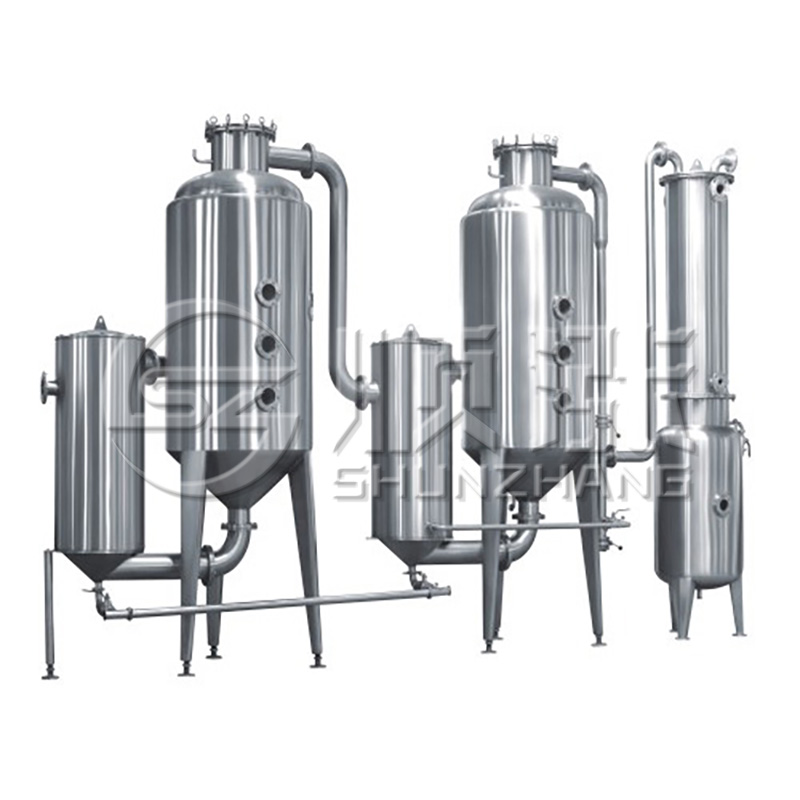
"As the core process equipment in the field of bioengineering, the energy consumption level of the extraction and concentration system directly affects the production efficiency and operating costs. In bio-engineering applications such as biopharmaceuticals, bio-fermentation, enzyme production, etc., the extraction and concentration process usually occupies more than 30% of energy consumption in the whole process, so the innovation and application of energy-saving technologies are of great significance to enhance industrial competitiveness. Traditional extraction and concentration systems often have low thermal efficiency, high solvent loss, poor operational stability and other problems, resulting in energy waste and rising production costs. With the rapid development of bioengineering technology and the continuous improvement of energy saving and emission reduction requirements, the research of energy saving technology of extraction and concentration system has become a key area of concern for the industry. By optimizing the system design, improving the process parameters, applying new energy-saving materials and intelligent control technology, the energy consumption of the extraction and concentration process can be effectively reduced, the efficiency of resource utilization can be improved, and the green and sustainable development of the bioengineering industry can be promoted.
The basic working principle of an extraction and concentration system is to utilize heat, vacuum or membrane separation, etc.The extraction and concentration systems are designed to evaporate or separate solvents from solutions such as biological fermentation broths, plant extracts, etc., to achieve concentration and purification of the target products. According to the different operating principles, the extraction and concentration system can be divided into thermal evaporation type, membrane separation type and crystallization type and other forms. Thermal evaporation system by heating the solvent vaporization, is the most traditional way of concentration, its energy consumption mainly from the heating steam consumption. Membrane separation system utilizes the selective permeability of semi-permeable membrane to realize the separation of solvent at room temperature, which has the advantages of low energy consumption and mild operation temperature, but the requirement of membrane material is higher. The crystallization type system, on the other hand, makes the target product crystallize and precipitate by controlling the temperature and concentration, and is suitable for the concentration of heat-sensitive substances. In practical application, it is often necessary to choose a suitable extraction and concentration process according to the material characteristics, product requirements and energy conditions, or use a combination of multiple technology solutions to achieve the best energy-saving results.
Optimization of system design is a key component in improving the energy efficiency of extraction and concentration. In the thermal evaporation system, the application of multi-effect evaporation technology can significantly reduce steam consumption. Multi-effect evaporation through the former evaporation of the secondary steam generated as a heat source for the latter evaporation, to achieve the gradient utilization of thermal energy, the theoretical steam consumption can be reduced to a single-effect evaporation of 1/2 to 1 / 3. In practice, the two-effect, three-effect and even four-effect evaporation system has been widely used in the field of bioengineering, energy saving effect is obvious. The adoption of plate evaporator further enhances the thermal efficiency by increasing the heat transfer area and improving the heat transfer coefficient. Compared with the traditional tube evaporator, the heat transfer coefficient of plate evaporator can be increased by 2-3 times, and under the same processing capacity, the volume of the equipment is smaller and the heat loss is less. The optimized design of the vacuum concentration system, on the other hand, reduces the boiling point of solvents and reduces the need for heating steam by lowering the operating pressure. Under vacuum conditions, the boiling point of water can be reduced to 60°C or even lower, which not only reduces energy consumption, but also reduces the damage to heat-sensitive bioactive substances.
Precise control of process parameters is essential for energy-efficient operation of extraction and concentration systems. The choice of operating temperature requires an optimal balance between energy consumption and product quality. Too high a temperature increases steam consumption and may lead to degradation of heat-sensitive components; too low a temperature decreases the evaporation rate and prolongs processing time, again increasing energy consumption. For most bioengineered materials, controlling the evaporation temperature in the range of 60-80℃ tends to get better energy-saving results. The control of vacuum degree directly affects the energy consumption level of the system, higher vacuum degree can reduce the evaporation temperature, but will increase the energy consumption of the vacuum pump. By optimizing the design of the vacuum system, such as using a combination of water ring vacuum pumps and steam injection pumps, the energy consumption of the vacuum system can be reduced while ensuring sufficient vacuum. The control of flow rate and concentration, on the other hand, is related to the stable operation of the system, and the increase of energy consumption due to operation fluctuation can be avoided through online monitoring and automatic adjustment. The optimization of reflux ratio is also an important measure for energy saving, appropriate reflux can ensure the separation effect, but too large reflux ratio will increase the energy consumption, and it is necessary to determine the optimal range of reflux ratio through experiments.
The application of new energy-saving materials has opened up new possibilities for energy efficiency improvements in extraction and concentration systems. The development of high-efficiency heat transfer materials has led to a significant improvement in the heat transfer efficiency of evaporators. Nano-coating technology can form superhydrophobic or superhydrophilic coatings on the heat transfer surface, improving the flow characteristics of the liquid film and increasing the heat transfer coefficient.Graphene, carbon nanotubes and other new heat-conducting materialsIn contrast, the heat conductivity of the heat exchanger has been dramatically improved. Breakthroughs in high-performance membrane materials have made membrane separation technology more widely used in the field of bioengineering. New composite membranes, organic-inorganic hybrid membranes and other materials with higher selectivity and flux, can be achieved at lower pressure to achieve effective separation and reduce energy consumption. The application of corrosion-resistant materials extends the service life of the equipment and reduces the increase in energy consumption and maintenance costs due to equipment corrosion. Titanium alloy, Hastelloy, special stainless steel and other materials in the strong corrosive medium of good performance, so that the extraction and concentration system can be more demanding conditions of stable operation. The improvement of insulation material reduces the heat loss of the system. The thermal conductivity of the new aerogel insulation material is as low as 0.02W/m-K, which is one order of magnitude lower than that of the traditional insulation material, and significantly reduces the heat loss of the system.
The introduction of intelligent control technology makes the energy-saving operation of the extraction and concentration system more accurate and efficient. The application of advanced process control system can automatically adjust the operating parameters according to the real-time characteristics of the materials to realize the optimal energy-saving operation. The model prediction control technology predicts the future operation state by establishing a mathematical model of the system and adjusts the control parameters in advance to avoid fluctuations in energy consumption. The expert system, on the other hand, integrates the experience and professional knowledge of operators to provide intelligent operation guidance when facing complex changes in operating conditions. The advancement of online monitoring technology makes the energy consumption management of the system more refined. Multi-parameter sensors can monitor key parameters such as temperature, pressure, flow rate, concentration, etc. in real time, providing data support for energy-saving control. The application of spectral analysis, near-infrared detection and other rapid analysis technologies realizes online monitoring of product quality, avoiding repeated processing and waste of energy consumption caused by substandard product quality. The establishment of the energy management system optimizes energy use from a global perspective by analyzing the energy consumption of the entire production process, identifying bottlenecks in energy consumption and formulating targeted energy-saving measures. The application of Internet of Things (IoT) technology enables multiple extraction and concentration systems to operate in a network to achieve centralized monitoring and synergistic optimization, which further improves the efficiency of energy use.
In the specific application scenarios of bioengineering, the energy-saving technologies of extraction and concentration systems present diverse characteristics. In the field of biopharmaceuticals, the protection of heat-sensitive substances in the extraction and concentration process of antibiotics, vitamins and other products is an important consideration in the application of energy-saving technologies. The application of low-temperature concentration, membrane separation and other technologies realizes the reduction of energy consumption while ensuring product activity. In the production of enzyme preparations, since enzyme proteins are sensitive to temperature, membrane separation technologies such as ultrafiltration and nanofiltration are often used for concentration, which avoids the influence of high temperature on enzyme activity. In the field of plant extraction, the extraction and concentration of natural products such as flavonoids, polysaccharides, alkaloids, etc., usually need to deal with a large number of raw materials, and energy-saving technologies are more economical. The application of multi-effect evaporation, heat pump evaporation and other technologies can significantly reduce steam consumption and improve the economy of production. In the post-treatment process of fermentation solution, bacteria separation, product extraction, solvent recovery and other links are related to the extraction and concentration system, through the energy-saving optimization of the whole process, it can achieve a significant reduction in overall energy consumption. In wastewater treatment, the extraction and concentration system is used for the reduction and treatment of high-concentration organic wastewater, and the application of energy-saving technology not only reduces the treatment cost, but also creates conditions for the recycling of resources.
The development of energy-saving technologies for extraction and concentration systems shows a trend of integration, intelligence and greening. The progress of system integration technology makes it possible for different types of extraction and concentration technologies to be better combined and applied, giving full play to their respective advantages. The integrated system of thermal evaporation and membrane separation can minimize energy consumption by adopting the most suitable technology at different stages. Multi-technology coupling system, on the other hand, improves separation efficiency and reduces energy consumption through the synergistic effect of chemical reaction, physical separation and other means. The enhancement of the level of intelligence allows the extraction and concentration system to more accurately adapt to changes in materials and realize adaptive energy-saving operation. The application of artificial intelligence, machine learning and other technologies enables the system to learn optimization strategies from historical data, and continuously improve energy-saving effects. Green development is reflected in the minimization of environmental impact and recycling of resources. The application of technologies such as the utilization of low-grade heat source, the recovery of waste heat, and the access to renewable energy makes the energy structure of the extraction and concentration system greener. The recycling of solvents, resource treatment of by-products and other measures improve the utilization efficiency of resources and reduce the emission of waste. With the continuous development of the bioengineering industry and the increasing requirements for energy saving and emission reduction, the research on energy-saving technologies for extraction and concentration systems will continue to be in-depth, providing technical support for the sustainable development of the industry.
"As a major energy consumer in bioengineering production, the innovation and application of energy-saving technologies are of great significance in reducing production costs and improving industrial competitiveness. Through the optimization of system design, process parameter control, application of new materials and the introduction of intelligent technology and other aspects of technical improvement, can significantly improve the energy efficiency level of the extraction and concentration system. In the future, with the continuous development of new materials, new processes and intelligent technology, the energy-saving potential of the extraction and concentration system will be further released, providing strong support for the green transformation and sustainable development of the bioengineering industry. In practical application, it is necessary to select appropriate energy-saving technology solutions according to specific production conditions and product requirements to realize the unity of economic and environmental benefits.
 简体中文
简体中文  English