
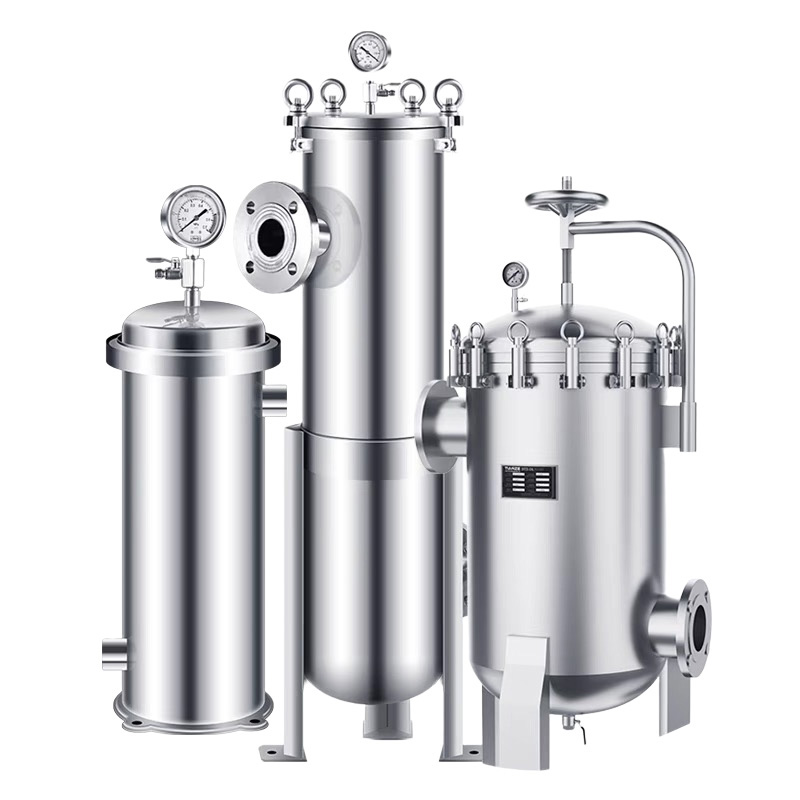
In the modern food and beverage industry, the application of stainless steel precision filters is becoming more and more widespread, and it has become an important tool for improving production efficiency and product quality. In this paper, we will objectively analyze the application characteristics and technical points of stainless steel precision filters in the food and beverage industry from the perspectives of technical principle, structural design and performance parameters.
I. Technical principles and basic structure
1.1 Filtration Mechanism
Stainless steel precision filterMainly based on the physical interception principle, the separation of solid particles is realized through the microporous structure of the filter element. According toStokes's law (1929-)The settling velocity of particles in a fluid is proportional to the square of the particle size. When the fluid passes through the filter element, particles larger than the pore size of the filter element are retained on the surface or inside the filter element, thus realizing solid-liquid separation.
1.2 Typical structural components
Shell structure: usually cylindrical design, to withstand the working pressure
Filter cartridge: the core filtration unit, determines the filtration precision
Sealing system: ensures a leak-free filtration process
Inlet and outlet connections: standardized pipe connection design
Pressure monitoring device: real-time monitoring of filtration status
II. Material selection and technical requirements
2.1 Main Material Characteristics
Food grade stainless steel materials need to meet the following technical requirements:
Chemical composition: in line with GB 4806.9-2016 standard
Corrosion resistance: able to withstand acids, alkalis, salts and other media commonly found in foodstuffs
Surface treatment: inner surface roughness Ra≤0.8μm, easy to clean
Welding quality: weld seam smooth, no cracks, pores and other defects
2.2 Selection of cartridge material
Depending on the filtration precision requirements, different materials can be selected for the filter element:
Stainless steel sintered wire mesh: precision 1-100μm, high strength, reusable
Polypropylene filter bag: precision 5-200μm, lower cost, one-time use
Ceramic cartridge: precision 0.1-10μm, high temperature resistance, long service life
III. Analysis of key performance parameters
3.1 Definition of Filtration Accuracy
Filtration accuracy is usually measured in microns (μm) and indicates the smallest particle size that the cartridge can effectively intercept. One thing to keep in mind:
Nominal Accuracy: Manufacturer's nominal filtration capacity
Actual precision: filtration effect under actual use conditions
Retention efficiency: Percentage removal of particles of a given size
3.2 Flow rate versus pressure drop
groundDarcy-Weisbach formulaThe pressure loss of a fluid through a cartridge is proportional to the square of the flow rate:
ΔP = f × (L/D) × (ρv²/2)
where ΔP is the pressure drop, f is the coefficient of friction, L is the length of the cartridge, D is the diameter of the cartridge, ρ is the fluid density, and v is the flow rate.
3.3 Calculation of sewage capacity
Pollutant holding capacity refers to the total amount of pollutant that can be retained by the cartridge before the rated pressure drop is reached:
C = K × A × t × ε
C is the dirt-holding capacity, K is the filter media characteristic coefficient, A is the filter area, t is the cartridge thickness, and ε is the porosity.
IV. Hygienic design and cleaning requirements
4.1 Dead-end design principles
In order to achieve thorough cleaning, the filter design needs to follow the following principles:
Arc transition: all corners are designed with R≥25mm arcs.
Emptying design: the lowest point is set up with an emptying port to ensure no residue.
Removable structure: key components can be easily disassembled and cleaned.
V. Application characteristics in different industries
5.1 Fruit Juice Beverage Industry
Technical requirements: need to resist fruit acid corrosion, filtration precision 10-50μm
Special Considerations: Preventing Loss of Vitamins and Flavor Substances
Process characteristics: usually using multi-stage filtration, roughing + fine filtration combination
5.2 Dairy industry
Technical requirements: need to be resistant to protein adhesion, easy to clean
Special considerations: protection against fat oxidation and microbial contamination
Process characteristics: filtration is required before and after pasteurization
5.3 Brewing industry
Technical requirements: need to be resistant to alcohol and organic acid corrosion
Special considerations: preservation of flavor substances, removal of sediments
Process characteristics: clarification and filtration after fermentation is the key link
VI. Selection of technical points
6.1 Main considerations
Fluid characteristics: viscosity, density, corrosivity, temperature
Processing requirements: flow rate, filtration accuracy, dirt-holding capacity
Installation conditions: space limitations, interface specifications, operating environment
Maintenance requirements: cleaning frequency, cartridge replacement intervals, spare parts availability
6.2 Matching of technical parameters
Capacity Matching: Select the appropriate specification according to the maximum capacity.
Precision selection: determine the appropriate filtration precision according to product requirements
Adaptation of materials: Selection of suitable materials according to the corrosive properties of fluids
Pressure level: design pressure is determined according to the system pressure
VII. Technical guidelines for maintenance and upkeep
7.1 Daily inspection program
Pressure monitoring: recording of inlet and outlet differential pressure changes
Seal Check: Periodically check the condition of the seals
Surface Cleaning: Keep the exterior surfaces of the equipment clean
7.2 Contents of periodic maintenance
Filter cartridge replacement: regular replacement according to pressure difference or usage time
Seal renewal: replace seals every 1-2 years
Integrity testing: periodic pressure testing and leak detection
summarize
The technical selection and application of stainless steel precision filter requires comprehensive consideration of fluid characteristics, process requirements, equipment performance and other factors. Correct selection and reasonable maintenance is the key to ensure the filtration effect and equipment life. With the continuous improvement of product quality requirements in the food and beverage industry, the filtration technology is also constantly developing and improving, and enterprises should choose the appropriate technical solutions according to their actual needs to ensure the high efficiency and stability of the production process.
 简体中文
简体中文  English